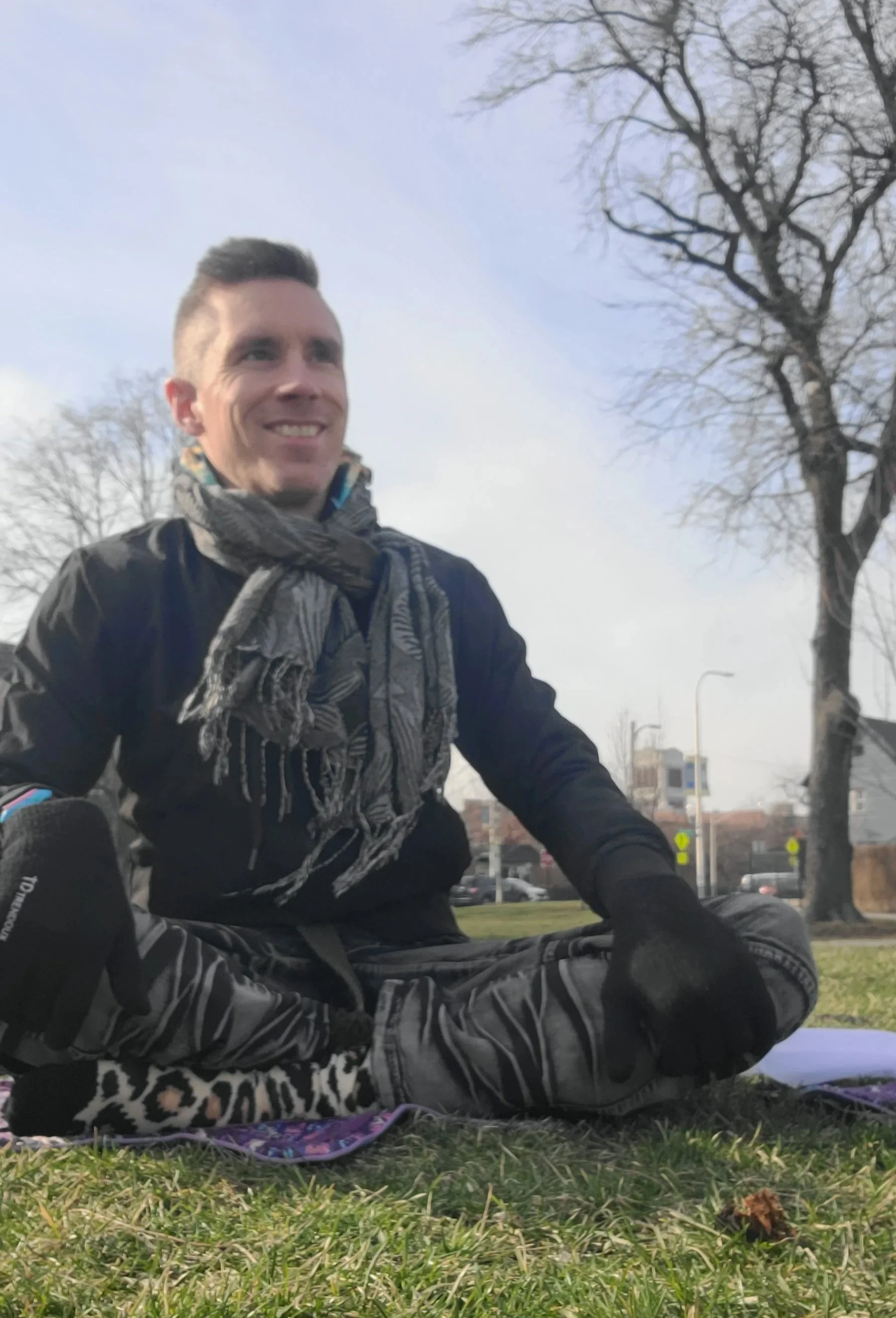
Becoming Balanced Tiger
By Tiger
born Matthew Ford, July 1988
Chicago
March 26, 2026
Intro — Becoming
There is a difference between choosing a name and realizing you have already been becoming it.
For a long time, the names I carried reflected real phases of my life, but not yet the deeper Self I was moving toward. Looking back now, I can see a progression that feels less like reinvention and more like recognition. Not a sequence of masks, but a gradual unmasking through a sequence of truths, each one naming a stage in my journey, each one carrying me toward something more embodied, more authentic to myself.
That unmasking has been inseparable from coming to understand myself as AuDHD. It has shaped not only how I understand my past, but how I recognize the delayed, layered way self-knowledge often arrives for me. Some truths do not land all at once. Sometimes I live them first, and only later understand what was already changing.
“Becoming Balanced Tiger” is not the story of inventing a new identity. It is the story of recognizing a truer pattern of embodiment already underway, and consciously stepping more fully into it. It is the story of learning to appreciate the journey without becoming fixated on the destination.
Never Comfortable — A Truthful Name for a Painful Era
My earliest Burner name, Never Comfortable, was not inaccurate. It fit painfully well at the time.
That name came before self-awareness of my neurodivergence. Never Comfortable names a chapter of my life in which I felt deeply dysregulated and profoundly uncomfortable in my everyday existence. In that sense, it named something very real.
It is also important to me to honor that it was a given name. There is something genuinely beautiful in Burning Man culture about names being given by others rather than being selected for oneself. A gifted name can carry recognition, community witnessing, and a kind of truth that emerges relationally. For that gift to be real, it must also be freely and faithfully accepted in the spirit of Consent. Never Comfortable belongs to a real chapter of my life, and it named that chapter honestly.
Almost Comfortable — The Beginning of a Turn
Almost Comfortable was not the name of arrival. It was the name of a turning.
Around that same period, I had also come into contact for the first time with the ideas and culture of the Burning Man movement.
It was sometime after I received and began carrying the name Never Comfortable following my first Burn that I had a profound psychedelic experience which made me aware that I was ready for therapy — a realization that had been growing within me for some time. I name that experience simply because it was real and because it belongs to the truth of this story. It did not solve everything for me, but it helped bring me to a point of recognition: I was ready to seek deeper support and to begin relating to myself differently. In that moment, for the first time in my life, I realized that I did not have to constantly fight my discomfort; it was possible for me to become more comfortable and to love myself. This marked a shift from feeling like a passive observer of my life to becoming a more active participant in my own lived experience.
Around that same period, I experienced an identity shift from Never Comfortable to Almost Comfortable in November of 2024, when I began therapy for the first time in my life. Within my first few sessions, I came to understand myself as AuDHD. That timing matters to me, because it means this was not merely a change in language. It was part of a deeper process of self-recognition, support, and reclamation.
Almost Comfortable was a transition in the right direction. It named a threshold rather than a destination. I was not yet fully at home in myself, but I was beginning to believe that such a life might actually be possible. In that sense, the name was honest. It carried both the truth of what had changed and the truth of what was still unfinished.
Tiger — Chosen Recognition
Before Balanced Tiger, there was Tiger.
At a certain point, the journey became more than a shift in Burner naming. I began reclaiming myself more directly by changing my everyday name from Matt to Tiger. That mattered in a different way. It was no longer only a relational or cultural naming process. It was a conscious act of self-authorship.
If Almost Comfortable named the threshold, Tiger named recognition. It marked the point at which I was no longer only approaching myself, but beginning to call myself by a truer name. Tiger did not feel like a persona or an invention. It felt closer to my core, closer to something fundamental, closer to the Self I had already been becoming.
Looking back, I can now see that becoming Tiger was not a break from the journey that came before. It was a deepening of it. It was the moment when nearness became something more deliberate. Not full arrival, but a more conscious claim.
Balanced Tiger — Embodied Orientation
Balanced Tiger did not arise as a rejection of Tiger. It emerged as a refinement of it.
If Tiger named recognition, Balanced Tiger names embodiment. It reflects a more integrated relationship between strength and softness, instinct and awareness, power and regulation. It is not the name of a perfected self, but of a Self becoming more consciously aligned.
This realization did not arrive all at once. In some ways, I had already begun moving toward Balanced Tiger before I fully understood what was happening. I had changed my social media handles to Tiger and began reinforcing the name across other platforms. I was already living into it through meditation, readings, and practice before my conscious mind fully caught up. That delayed recognition feels familiar to me. Often, I do not understand the full meaning of a change until after I have already begun inhabiting it.
Balanced Tiger is not generally what I introduce myself as. Tiger remains the name I call myself in everyday life. Balanced Tiger feels more like a perception of myself: a way of naming the state of being I am growing into. It is less an interpersonal identifier than an inner orientation.
Balanced Tiger also helped clarify something else for me: Big Cat Energy is not the same thing as Tiger. Big Cat Energy feels more like an expressive extension of me, an energetic and artistic interface through which I communicate, create, and resonate. Tiger feels closer to my core identity, closer to the deeper Self underneath the expression. If Big Cat Energy represents an extension of ego through persona, Tiger feels more like a bridge between persona and Self. Balanced Tiger is what it feels like when that deeper identity becomes more consciously embodied, the representation of Self.
That is why this name feels so resonant to me. It is not a costume, and it is not a brand. It is a truer naming of the state of being I am learning to inhabit.
True Tiger — Horizon, Not Endpoint
If Balanced Tiger names the embodied orientation I am growing into, True Tiger names the horizon that calls me forward.
I do not experience True Tiger as a fixed destination I will one day fully reach and permanently possess. It feels more like a Self-actualized horizon: a vision of deeper authenticity, fuller embodiment, and more complete alignment that I can orient toward without ever fully exhausting. In that sense, True Tiger is less a final identity than a kind of True North Star.
That distinction matters to me. I am not interested in pretending that I have arrived at some perfected state of being. Part of what makes this path meaningful is that it remains alive, unfinished, and participatory. There is always more to unmask, more to embody, more to understand, and more to integrate. The journey does not lose value because it is incomplete. If anything, that incompleteness is part of what gives it depth.
This is one reason Becoming Balanced Tiger feels truer to me than any claim of final arrival. I am becoming, not finished. I am learning to live in a more conscious relationship with my own authenticity, not to declare myself complete.
True Tiger exists for me, of that there is no doubt. But it exists as the image of what full self-authenticity points toward: not a fixed state, but an orientation. Not something I can hold once and for all, but something I can keep moving toward as my True North, my guiding star — even when the path feels dark.
Why It Matters — Living by Example
This story matters to me not only because it names my own journey more truthfully, but because of what I have seen happen when people encounter lived authenticity in others.
I do not believe in telling people who they should be. I do not think that kind of transformation can be prescribed from the outside. What I believe in, instead, is living visibly enough that people can recognize something in themselves through what they witness in others. I try to lead by example. By word and action, I say: “Here is what I am doing. Here is how I am living. Here is what I am learning.”
Again and again, I find that people respond not because I have instructed them, but because they can feel the self-authenticity behind the words and the deeds. They see how strength grows when a person becomes more embodied, more self-aware, and more self-aligned. They feel how that kind of honesty can be empowering. And in that recognition, they often feel permission and agency to move toward themselves too.
For me, this path is not shapeless. It is grounded in the 11 Principles that have become the core values framework of my journey, with Consent as the foundational Principle that ties all of the rest together. The Principles of the Burning Man movement helped give language and structure to values I was already reaching toward but had no roadmap for, and they continue to shape how I relate to myself, how I relate to others, and how I move through the world. They are not just ideals to admire. They are values to practice. They are a framework for living the Authentic Path.
What matters to me about that framework is that it shows up in ordinary life, not only in dramatic moments. The Principles are also tested in small decisions: how I present myself, how I handle attention, whether I convert expression into transaction, and whether I allow authenticity to remain intact when easier, more rewarded alternatives are available. That kind of practice matters to me because it is empowering to others to witness self-authenticity lived visibly and without apology.
The Authentic Path is best demonstrated in small examples drawn from daily life. One such instance: I chose not to tag the maker of a shirt I was wearing in a social media post, even though doing so would have been easy and socially rewarded. I chose not to because decommodification is not, for me, an abstract Principle or a piece of language that sounds good in theory. It is something I embody in my daily life. This choice preserved the post as immediacy rooted in radical self-expression rather than transaction. To present it any other way would have taken away from the message I was trying to communicate through symbolism and aesthetic coherence.
That is part of what The Tiger Experiment has come to mean for me. It is not a project of self-branding or performance. It is a project of Self. It is a lived experiment in what becomes possible when a person commits, as honestly as they can, to embodiment, self-authorship, participation, and authentic becoming. If that journey resonates with others, I hope it is because they recognize something in themselves that feels more possible in its presence. My wish is for everyone to become the hero of their own journey.
That is why this story feels worth telling. It is beyond personal. It is one example of what can happen when a life begins to orient more fully around truth, embodiment, and the courage to keep becoming.